Rick, Chris, Jim Hiltz, Jim MacLean, Brian, Wilson, Miles.Paul
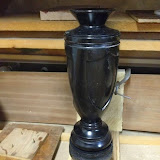
Leo spent a lot of time explaining the steps in gold leafing the vase:
Supplies needed:
Gesso, made from the following ingredients:
Yellow ochre pigment: Whiting (sifted limestone)
(Not much yellow is needed)
Fish glue
Good brushes
Gold leaf
Transfer paper for real gold leaf
Eraser (rubber)
Paper towel
Paint the vase: brush it on well: spend a long time at this and do several coats
Sand between coats using paint thinner on the sand paper: start at 320
Spray on lacquer
Cut out the grooves again to expose the wood
Brush on concrete bond: let dry
Brush on the yellow pigment:whiting , mixing it with bond: this gives a very hard surface
Sand out the groove and recoat
Then brush on fish glue (or sizing)
Let it dry
The gold leaf is brushed lightly with water and laid in the groove.
The water melts the fish glue!
Apply the goldleaf gingerly and press it down using a rubber
Let it dry
Can do a second layer
Then burnish with agate
Tips:
Don’t use Tempura pigment for this project
Try to get turpentine to soak your brushes in: it is better than paint thinner
A good brush springs back after the paint stroke
Leo demonstrated how to cut thin veneer using two saw blades: the inside blade cuts: the outside blade is put on backwards: this prevents the blade from wandering and planes the wood.
First cut a veneer about 1/8 thickness
Then run this through the two blade set up.
Bring the blade close to the table insert edge: use a cardboard washer if necessary to get the teeth very close to the edge of the insert so the thin veneer does not drop down into the space
Supplies needed:
Gesso, made from the following ingredients:
Yellow ochre pigment: Whiting (sifted limestone)
(Not much yellow is needed)
Fish glue
Good brushes
Gold leaf
Transfer paper for real gold leaf
Eraser (rubber)
Paper towel
Paint the vase: brush it on well: spend a long time at this and do several coats
Sand between coats using paint thinner on the sand paper: start at 320
Spray on lacquer
Cut out the grooves again to expose the wood
Brush on concrete bond: let dry
Brush on the yellow pigment:whiting , mixing it with bond: this gives a very hard surface
Sand out the groove and recoat
Then brush on fish glue (or sizing)
Let it dry
The gold leaf is brushed lightly with water and laid in the groove.
The water melts the fish glue!
Apply the goldleaf gingerly and press it down using a rubber
Let it dry
Can do a second layer
Then burnish with agate
Don’t use Tempura pigment for this project
Try to get turpentine to soak your brushes in: it is better than paint thinner
A good brush springs back after the paint stroke
Then run this through the two blade set up.
Bring the blade close to the table insert edge: use a cardboard washer if necessary to get the teeth very close to the edge of the insert so the thin veneer does not drop down into the space