Showing posts with label lathe. Show all posts

Tuesday, December 5, 2017

Shellac flakes, Gold leaf, Staining Cherry

Keenan, Arno, Jim MacNeil, Jim Hiltz, Rick, Paul, John

Leo set up an old Craftex lathe that Miles had sent over and started to explain to the new members the principals of lathe work.

Arno wants to have Leo take them through the bowl process starting from scratch--ie the raw wood blank from the tree.

Paul worked on the Gold leaf vase. Jim Macneil helped out with that.

Jim Hiltz brought in a finished bowl, ready for staining and finishing.

Leo discussed finishing Cherry.
It is very hard to stain as the end grain absorbs too much stain. Best approach is;

Finish sand to 800-1000 or higher
Spray on Shellac.  Shellac is food safe. It is a biological product gathered from a certain tree species. Insects produce the shellac.
Let that dry
Wipe on the stain . Mix the stain first with household ammonia. This makes the stain adhere; otherwise it would not .

Then let that dry and repeat the cycle a few times. This results in even staining. The more coats the darker the cherry will become.

Shellac is best made using flakes; blond or super blond best. (Available from Wood Essence-Canada)
Use one measure of flakes to 4 measures of Methanol.

Keep flakes in a dry place as they absorb moisture and get spoiled .

We discussed having a separate meeting with the new members over the Holidays to discuss plans for the upcoming workshops.

NOTE

Leo discussed Shellac. He is studying modifications on the use of the age old finish.
Shellac comes from the secretions of insects;

Lac is the scarlet resinous secretion of a number of species of lac insects, of which the most commonly cultivated species is Kerria lacca.
Cultivation begins when a farmer gets a stick (broodlac) that contains eggs ready to hatch and ties it to the tree to be infested.[1] Thousands of lac insects colonize the branches of the host trees and secrete the resinous pigment. The coated branches of the host trees are cut and harvested as sticklac.
The harvested sticklac is crushed and sieved to remove impurities. The sieved material is then repeatedly washed to remove insect parts and other soluble material. The resulting product is known as seedlac. The prefix seed refers to its pellet shape. Seedlac which still contains 3-5% impurities is processed into shellac by heat treatment or solvent extraction.
The leading producer of Lac is Jharkhand, followed by the ChhattisgarhWest Bengal, and Maharashtra states of India. Lac production is also found in BangladeshMyanmarThailandLaosVietnam, parts of China, and Mexico.

Shellac flakes can be dissolved in Methyl alcohol
They come in various colors: Orange, white, blond, and ultra blond: 
(Available at Wood Essence in Ontario) The flakes will deteriorate unless humidity is low.
Orange is the hardest to use as it colors up the grain too much
Use a ratio of:   1Flakes : 4 Methyl alcohol
This solution should be stable for a good while
This dilution is OK for spraying  use a low pressure or it will gum up on the surface of your wood.
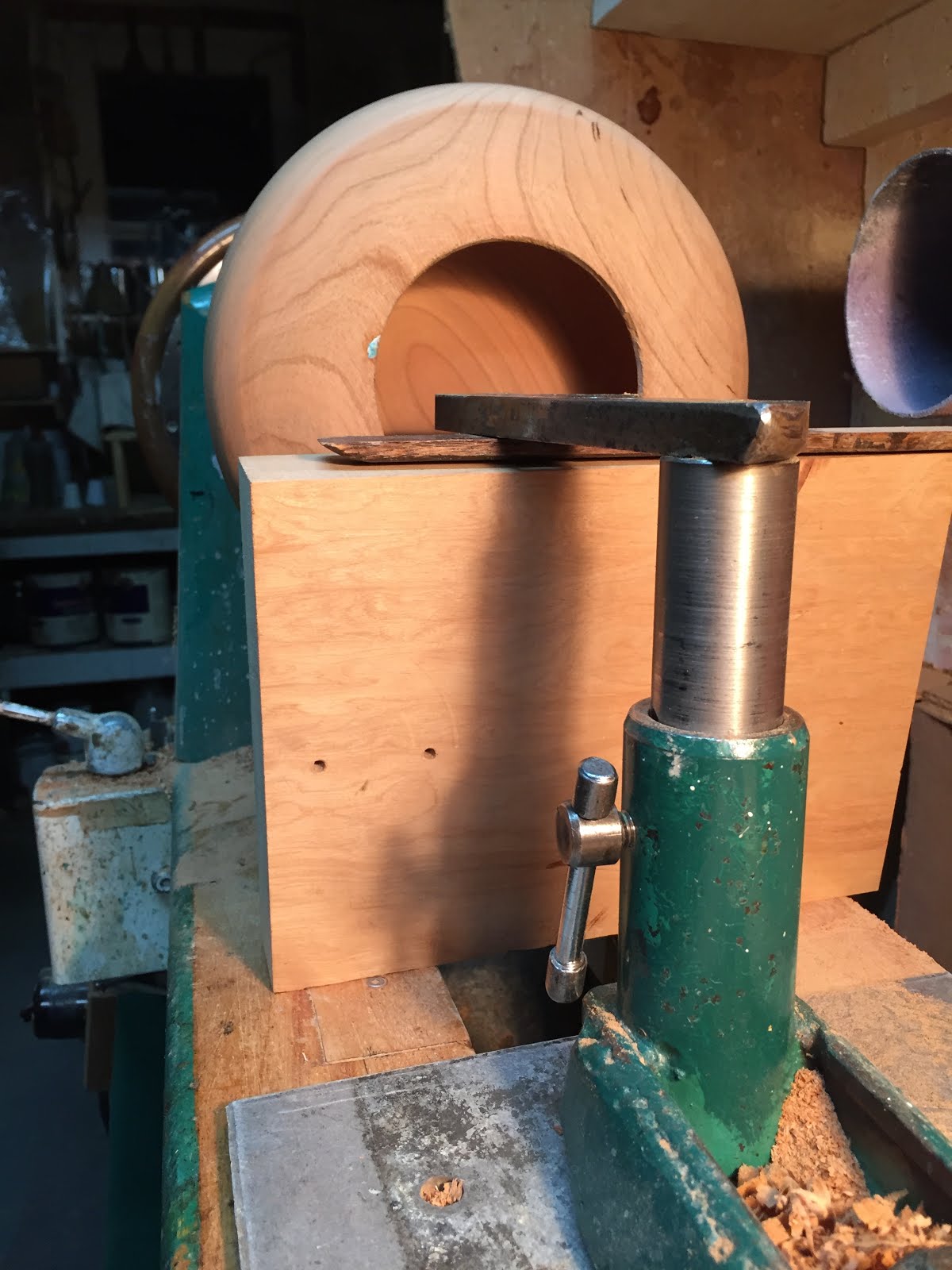
Jig for getting into the bowl to turn
Note the plate on lathe bed, the wood rest on which the metal arm sits

The L-shaped rest is sturdy  3/8 to 1/2 inch metal plate


Craftex Lathe ..beginners instructions

Wednesday, January 20, 2016

Big Bowls !

Rick, Him Hiltz, Miles, Chris, Paul

Some People brought in large blanks for turning.

Leo discussed the various paints: House paint vs Artists Craft paint vs Airbrush paints.
The differences is in the size of the pigment granules which matter as to whether the lines get blocked up in the spray gun.

If you paint using the whiting/bond/paint approach, be sure to start the sanding with coarse grain paper or the result  is a finish that is uneven

Leo demonstrated a simple jig for drilling  a log on the drill press: see photos. The jig is usable as a small stool as well!

Leo demonstrated how to use a jig on the lathe to drill angled holes at even distributions (indexed)

Rick mounted his large bowl using the spider chuck but it was too big for the machining jig-he has to start it using  hand power and a big gouge
Leos'Ammonia finished bowls

Jig to find leg height
Drill press jig-Blank is screwed on from top
Angle drilling using lathe and indexer

Ricks Bowl
Drilling on lathe


Tuesday, November 23, 2010

Meeting November 23,2010

Nov 23,2010
Wayne,Paul,J Hiltz, J Maclean, Rick, Wilson, Chris

Paul's notes:


Discussion about how to properly align the lathe continued.
Keep the tailstock aligned on one side of the ways all time for consistent results.
Leo has built in a spring memchanism on his, which pressed the tailstock against the sides of the ways.
One could drill a hole in the tailstock mechanism and insert a spring and have a ball bearing on the end to keep the side of the tailstock applied to the ways properly.
Leo went over his headstock “pivot chuck” for spindle turning.
Leo demonstrated an interesting way to use sand paper on a dowel to sand the inside of a hollow cylinder like the pepper mill.

Rick's Notes:

Lathe alignment review: Leo's tailstock has springs to keep it pushing against the outer way of the lathe bed.(A small coil spring with a ball bearing on the end) He also has a coil spring going down to prevent the tailstock from grabbing when sliding back and forth along the ways.

Leo tip #1 you can also use a flat spring from an old measuring tape to force the tailstock against the ways

Lt#2 when spraying epoxy sealer use a straw in the tube of the spray gun.You may have to drill a hole in the top fitting to allow for the straw. This keeps the gun clean and you just toss the straw.

Lt#3 use a lag bolt to thread the top of the pepper shaker for turning. This can be put in a jacobs chuck.

Lt#4To sand inside your pepper mill, take a dowel,split up about 1 1/2 inches with the bandsaw, put in a piece of 100 grit paper and secure with a small screw to hold it in place. Put this in your drill press and sand to your hearts content.

Paul tip # 1 It's best not to glue the top of the peppermill to the body of the mill. You'll have a devil of a job getting pepper in it!!!!

Discussed the anvill and how it is made.
Discussed the three jaw chuck and how it is turned into a spider chuck.
Meeting 10-11-23

Tuesday, November 9, 2010

Meeting/Nov9/10

From Djembe drum
November 9,2010

Paul, J Hiltz, J MacNeil, Wilson, Lawrence, Brant, Wilcox,Miles,Chris,Lawrence,
Wayne,Frank

Leo discussed the process of lining up the lathe headstock and tailstock:

Put a long rod or wooden piece in a chuck in the headstock and then turn the spindle slowly and make a circle mark with a pencil on the end of this piece. This center point (of the circle) is then lined up by precise measurement with the lathe ways using a square and ruler. The headstock will have to be moves one way or another to get the center exactly equidistant between the lathe ways.

A similar process is used for aligning the tailstock. A piece will have to be put into the tailstock. One way to do this is to find a pipe that fits exactly over the tailstock quill and then the same process is used to find the center of this piece and align it with the ways in the same fashion as was done for the headstock.

Leo helped some members drill out their stock for the salt shaker project.

Lawrence made an announcement about the new fee structure as regards dues.
The member will pay $100 in September for the yearly dues.
New members will attend 2 meetings at a cost of $25.00 and if they decide to stay will then pay the annual $100.00 dues.

Jime announced thet the Xmas party will be December 11 (Saturday night) at his house in Main å Dieu.