Attendance: Rick Jim Hiltz, Jim Maclean, Paul, Miles, Robert
Work continued on the mold project.
Paul and Jimmy Maclean had a mold blank ready. The Gelatin did shrink as Leo predicted.
A compound of Medussa cement and fine stone was mixed with a few dollops of Concrete bond and then small amounts of water added to produce a thick product. It is important to add small amounts of water gradually as too much water will spoil the mixture. This was poured into the mold and let set. The settling can be aided by using a sander under the mold box, tapping the box down on a solid base and then screeding the surface to get it smooth: the same process as when making a concrete slab.
Tip: the slower that concrete cures ( i.e. the slower that the water evaporates) the harder the finished product. Leo instructed us to wrap the pieces in plastic to slow the curing.
Leo says that , in place of Gelatin, one can use silicone to make the mold-the same silicone one uses for bathtub sealing. It hardens well and does not shrink.
Use Isopropanol as a parting agent. Coat the materials with this to ease separation of the pieces.
This is Rubbing alcohol : C3H8O is the chemical formula (Can also be written as : (CH3)2 CHOH)
http://www.ivyroses.com/Chemistry/Organic/Naming-Alcohols.php
Powdered brass, copper, aluminum can be used for the mold instead of concrete. Epoxy works as well.
Leo produced several examples of small items of art that were done from these powdered metals.
We agreed to meet Friday evening at the Art exhibit at UCB.
Tuesday, January 31, 2017


Tuesday, January 17, 2017


Above: Box, atnifreeze/water, Gelatin, Mixture poured into the box
Attendance: Rick , Jim Hiltz, Miles, Jim MacLean Paul
We started work on the mold and casting project.
Small boxes were made to accommodate the piece to be duplicated.
Leo explained that the boxes are made a little larger than the piece and a bottom is nailed on.
(Secure the bottom well: Paul's leaked the Gelatin , which made a mess!)
Shellac is applied to seal the wood.
The Gelatin is made by mixing:
Antifreeze (Ethylene glycol) 1:1 with water and heated in a pan of water. An equal volume of Gelatin is stirred in.
When the mixture is warm, it is poured into the box containing the work piece and let cool
A parting agent is needed- i.e. some sort of material to prevent the object from sticking to the gelatine.
We used wax-brushed on the wooden box before adding the Gelatin
Once the Gel sets the piece can be removed and then the agent you use poured into the gelatine mold
One can use plaster, cement, powdered bronze, epoxy mixed with brass or aluminum.
If it is not used quickly, this mold will shrink as water evaporates.
Tuesday, January 3, 2017
Rick, Miles, Jim MacLean, Jim Hiltz, Paul, Robert
The members brought in the Wood burl pieces for the CBU exhibit.
They will be displayed for the next month at the Gallery
Leo discussed the art of mold making and we agreed to start a project to make an open mold.
He went over the basic principals involved and demonstrated some to the media to be used: rubber, gelatine, cement
We will each bring in a shape and start the process next workshop
Tuesday, November 15, 2016
R MacDonald, Chris, Paul, Jim Hiltz and MacNeil and Miles
The group has decided to produce a burl project for entry into the CBU art exhibit. We need to have it ready by Xmas. Each man has a project consisting of odd shaped burls.
The plan is to make a base of legs for these.
Leo demonstrated how to fill in voids with epoxy .
Leo showed how easy it is to get a brilliant finish using shellac alone.
Tip: Use leather to apply Carnuba wax: use Cerium Oxide for the final finish
Tuesday, September 20, 2016


Tuesday, April 19, 2016
Attendance: Jim Maclean, Jim Hiltz, Rick, Chris, Paul, Robert
http://www.wood-database.com/
The link is for wood identification: excellent site
Leo has developed an idea to make a lathe that has the ability to counterbalance heavy blanks for turning.
He will attach an arm mechanism to the back of the headstock with weights than can slide to and from the center so that the blank will turn balanced.
He has yet to build the machine.
Rick has just about finished the big bowl and Leo demonstrated how to get the bump out of the bottom of the bowl using the cross slide.
Paul used the chain saw to gouge out the center of the large burl and then the gouge and mallet to shape the recess better. Rick brought along his accessory for the angle grinder which makes short work of grinding out wood in a big bowl like Paul is working on.

Tuesday, April 5, 2016
Tuesday, March 22, 2016
Bowl Woes
Rick and Paul were the only attendees
Regrets: Mr. Caldwell, Mr. Martel
Some discussion on whether we should suspend membership for Misters Hiltz and MacLean and Miles MacDonald. We finally agreed on giving them a second chance to redeem themselves but if they don't show for next meeting ,woe betide them!
Rick continues work on a big bowl using the bowl lathe. Leo adjusted the rollers-trued them up
Leo has completed a lovely, stylistic, tall vase using a silver inlay (aluminum actually)
(Photos available later)
Paul brought a small vase that was gold painted which Leo liked
Paul had a large bowl that had lots of epoxy fill and uses a sharp scraper to clean up the outside and remove the epoxy. Since the bowl was laying around the shape altered a little and a 3-jaw chuck will be needed to mount it for turning the inside. The outside is all finished
Leo Advised spraying on a good shellac coat BEFORE filing in with epoxy
Robert is working on making his own musical instrument using discarded hard drives, fiddle strings and sundry other parts...very mysterious but he seems to think it will work.
Paul's Gold painted piece


Paul's vase: Black acrylic paint/whiting mix; overpainted with a gold sparkle and then shellac
Tuesday, February 2, 2016
Big Bowls
Rick, Jim Hiltz, Jim MacLean, Chris, Miles, Paul
Leo spoke about indexing on the lathe.
To index an odd number eg 11 divisions: wrap a paper tape around the perimeter of the chuck and mark the exact circumference
Then place the same tape down on a surface
Measure the length of the tape start to the marked area.
Divide this measurement by 11 to get can approximate division
Use dividers to mark off the divisions and adjust the divider repeatedly so as you get exactly 11 even divisions
This is easy and fast to do
Jim Hiltz mounted his large bowl and proceeded to hand turn the outside-a slow laborious process
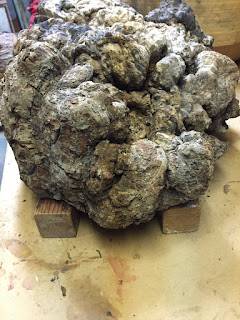
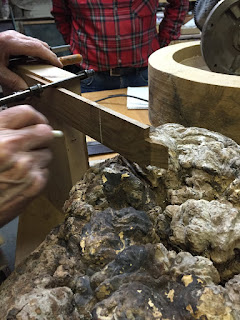
Leo helped Paul figure out where to place dowels in his uneven blank so as to be able to mount it on the lathe





Leo spoke about indexing on the lathe.
To index an odd number eg 11 divisions: wrap a paper tape around the perimeter of the chuck and mark the exact circumference
Then place the same tape down on a surface
Measure the length of the tape start to the marked area.
Divide this measurement by 11 to get can approximate division
Use dividers to mark off the divisions and adjust the divider repeatedly so as you get exactly 11 even divisions
This is easy and fast to do
Jim Hiltz mounted his large bowl and proceeded to hand turn the outside-a slow laborious process
Leo helped Paul figure out where to place dowels in his uneven blank so as to be able to mount it on the lathe


Subscribe to:
Posts (Atom)